How to get your kid to tell you about their day!
Start conversations to build recall skills

I often talk with parents who want to know about their child’s day at school. When they pick them up, the car-ride conversation doesn't get far. The child answers “I don’t know” or “I don’t remember” to most of the parent’s questions. As the adults, we’re left wondering if they really don’t remember who they played with or what they learned in class.
While we don’t have a way to know exactly what children can and can’t remember, speech-language pathologists do know that their language abilities often limit them from having these conversations. Relaying information about past events is a challenge for many children. But it’s a skill that can be taught- and it’s fun to teach!
Here’s the issue: conversations rely on our ability to talk about things not in our immediate environment. We talk about things that happened yesterday & things that will happen tomorrow. We talk about our ideas and our feelings. This language is called “decontextualized language” because we are talking about something not in the immediate context. So how can we help our kids bridge the gap between the simple “here and now” to these bigger ideas?
1. Connect books to your own life.
During story time, make connections between the book and real events in the child’s life.
A recent research review, Wei et al. (2025) discusses the benefits of modeling decontextualized language for children. They outline the importance of defining new concepts for children, using “extra-textual” talk during book reading, having conversations during pretend play, and retelling narratives.
While reading a book, this might sound like:
“That dog looks like our neighbor’s dog Milo.”
“Hey, we made smores too when we went camping!”
“She looks surprised. Do you remember what surprised you this morning at school?”

2. Make predictions about future events.
Talk with them about what the family doing tomorrow, next week, or next month.
This might sound like:
“I know Mrs. Smith will be at school tomorrow, I wonder who else will be there…”
“Maybe miss Alyssa will bring the ball popper to our house tomorrow. What do you hope she brings?”
“We’re going to Legoland next week! What do you think you might see there?”

3. Discuss past events
Retell stories! Include details of what you saw, what you thought about the events, and how you felt.
Elaborative reminiscing is a strategy used to discuss past events and narratives with children. Brien, A. & Hutchins, T. (2022) outlines the benefits of this strategy. Elaborative reminiscing helps start the conversation with observational statements or open-ended questions. The adult describes some details of a shared experience, naming what they saw, felt, thought, heard, and/or tasted. When the child adds to the conversation, a shared narrative is formed. This process solidifies their understanding and memory of the original experience. Elaborative reminiscing, and using decontextualized language in general, exposes children to higher levels of complex sentences and more advanced grammar.
Use a combination of you stating your recollection of the events, and pauses or questions to invite your child to add their input.
This might sound like:
“Remember when we went to the park this morning? I was surprised to see two bunnies in the grass! I remember seeing some other animals too…”
“That drawing you did at school looks great! Tell me about how you made it.”
“It was so disappointing when we got to the pool and it was closed. Then we had to drive all the way home after, and decide what else to do.”

4.Reduce your questions
We don’t need to eliminate questions, just think of it as adjusting your ratio. Make more statements and pauses, and sprinkle in a few questions.
When we think of teaching versus testing, we want to increase our teaching.
I aim for 75% teaching, 25% testing when I’m having conversations with kids.

5.Ask questions you know the answers to
When we do ask questions, especially about past events, we want to strengthen their ability to answer. While we don’t know the answers regarding events we were not present for (school, soccer practice, etc.), try to ask about things that happened at home- at least when you first start teaching this.
If they have trouble answering, don’t panic! This is where the teaching happens. Remind them of certain details without completely giving them the answer. Think of it as giving hints.
We can strengthen the pathways in their brain in order to help them come to the right answer. We can give hints by:
Reminding them what something looked like, smelled like, or sounded like.
Giving sentence starters and seeing if they can fill in the last 1-2 words.
Telling them similar but not correct answers. For example, if you are trying to remind the child that they met their neighbor’s dog, you can say, “Well we met an animal, but it wasn’t a cat…”
If they still need help, try giving a choice of two: “Did we meet the neighbor’s dog or bird?”

Try these strategies at home and tell me how it goes!
-
About the Author
Alyssa is a licensed speech-language pathologist practicing in San Diego, CA. She is the owner of Leap Speech & Language Therapy. Questions? Email her at alyssa@leapspeechandlanguagetherapy.com
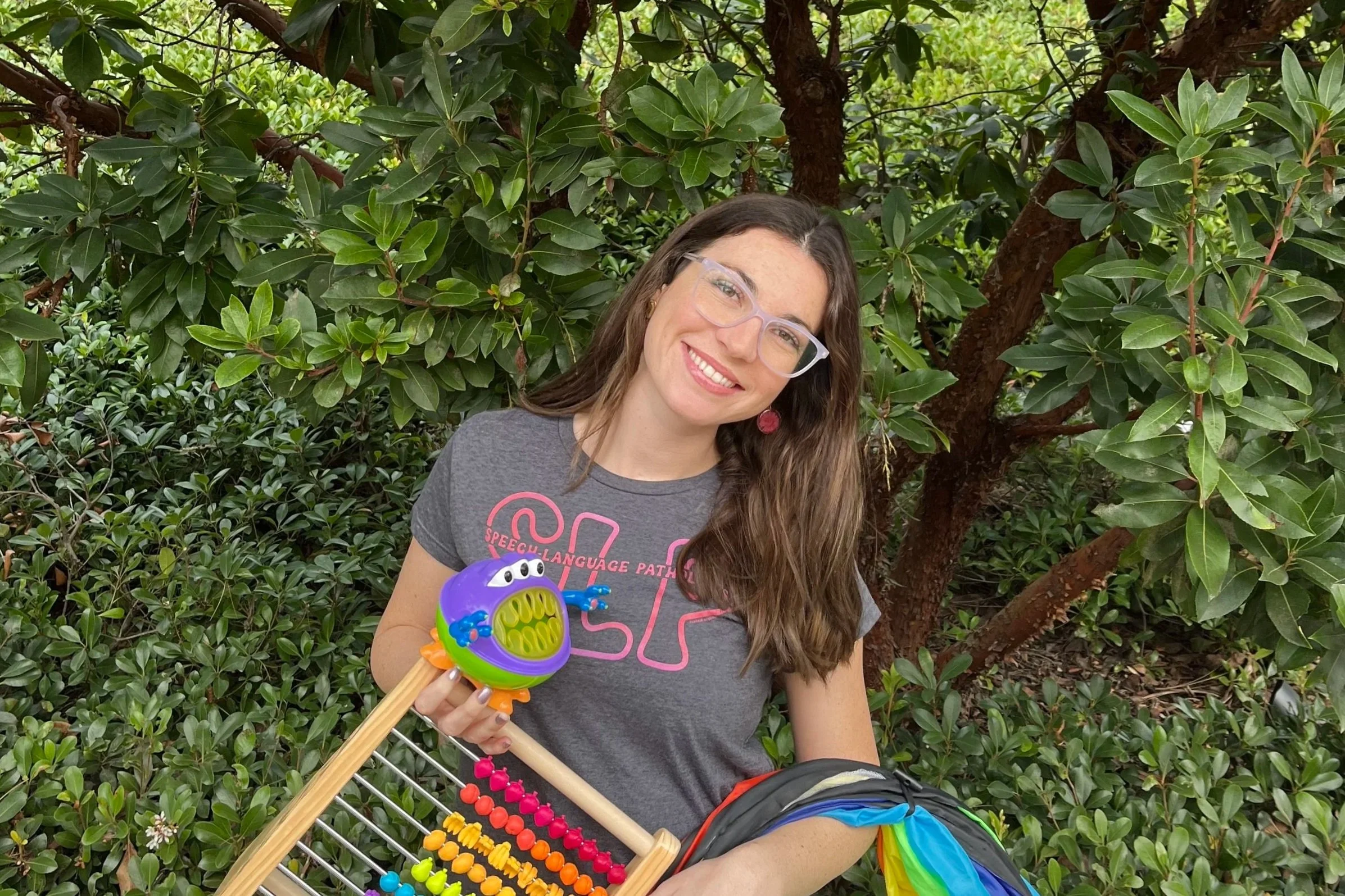
Alyssa Pitts, M.S. CCC-SLP
-
Citations
Brien, A. & Hutchins, T. (2022) Development of a Manualized Intervention to Support Episodic Memory in Autistic Children: Elaborative Reminiscing Is Key. Semin Speech Lang. 2022 Aug;43(4):299-315. doi: 10.1055/s-0042-1750349. Epub 2022 Jul 27. PMID: 35896407.
Clifford, A.E. et al (2024) Tender Shoots: Effects of a Preschool Shared Reading and Reminiscing Initiative on Parent-Child Interactions and for Socio-Emotional and Self-Regulation Outcomes After School Entry, Learning and Individual Differences 112 (2024) 102443
Wei, R., Harris, P. L., Snow, C. E., & Rowe, M. L. (2025). From the “here and now” to the “there and then”: How parent–child decontextualized conversations support early development. Developmental Review, 77, 101217.